

Macrostomum lignano
genome resources
genome resources

Emerging model for stem cell research
Macrostomum lignano is a free-living flatworm with high regeneration capacity facilitated by neoblasts, the stem cell system of the worm. It was first discovered in 1995 (described as a species in 2005) and since then has been the subject of research in several laboratories.
Due to its small size, short generation time, amenability to genetic manipulation and easy maintenance in laboratory conditions, M. lignano is a highly promising invertebrate experimental model whith a potential to become the next "C. elegans for stem cell research".
M. lignano genome has been sequenced and annotated. Furthermore, an efficient methods for transgenesis in M. lignano has been developed.
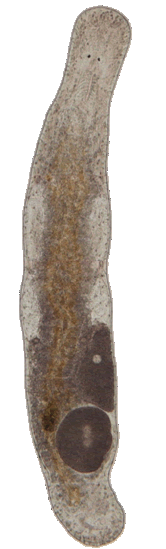
| Size | adults 1-1.5 mm; hatchlings 300µm |
| Cell numbers | ~25.000 total; ~1600 neoblasts; ~400 S-phase, ~25 mitotic |
| Culture in laboratory | easy; feed on diatoms; kept in Petri dishes with algae and light |
| Transparency | highly transparent |
| Embryogenesis | 5 days; Spiral quartet |
| Generation time | 18 days |
| Reproduction | exclusively sexual; obligatory cross-fertilizing hermaphrodite; lay single cell eggs (100µm) |
| Accessibility to eggs | single eggs, whole year through |
| Nervous system | simple; brain with neuropile; 2 main lateral nerve cords; a pair of dorsal and ventral cords; 16 serotoninergic cells; limited number of peptidergic nerve cells |
| Muscle system | 3 layers, outer circular, inner longitudinal and diagonal muscles |
| Testes | continuous sperm production; surrounded by tunica cells; outer region with spermatogonia and spermatocytes; below spermatids; inside mature sperm. |
| Ovaries | oogonia and oocytes |
| Morphological knowledge | well established |
| Plasticity | high; can endure extreme starvation (degrowth); testes size depends on group size |
| Regeneration potential | head regenerates posterior end with gonads; posterior end makes no new head |
| Phylogenetic position | basal platyhelminth; member of Lophotrochozoa |
| Stem Cell System | pluripotent |
| BrdU/H3 Staining | easy, by soaking |
| RNA interference | easy, by soaking |
| Transgenesis | easy, by microinjection into single-cell stage embryos |
| Genome size and availability | 500 MB, annotated genome assembly available |